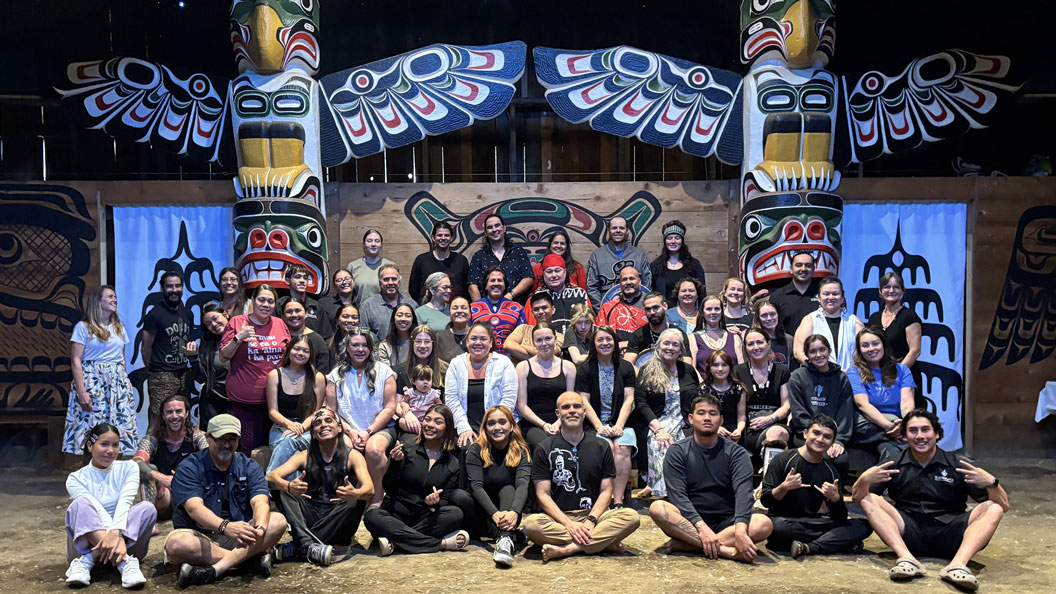
While North Island College has hosted international students for short visits before, it now gets to host its first-ever field school for them.
A group of 17 students from different countries and their teachers are in the region through June 5 after starting the field school on May 25. The field school is bringing together Indigenous students from Hawaiʻi, Aotearoa (New Zealand) and Mexico, along with Indigenous students from Vancouver Island.
Previously, Indigenous students from Vancouver Island have gone to field schools where the current visitors live, though NIC and First Nations from the region got to play host this time. Nations who hosted during the field school include Tseshaht First Nation [c̓išaaʔatḥ], Tla-o-qui-aht First Nation, Ucluelet First Nation Yuułuʔiłʔatḥ, K'ómoks First Nation, Kwagu'ł First Nation, Liǧʷiłdax̌ʷ - Wei Wai Kum, We Wai Kai and Homalco First Nation.
Kelly Shopland, Executive Director of Indigenous Education, said NIC was looking forward to being able to welcome the friends they made from the field schools North Island College students attended and continue past conversations.
“It’s meaningful for us to welcome our relatives and partners from across the ocean onto our territories. This is about more than hosting, it’s about renewing relationships, learning from one another and strengthening the connections that tie our Nations together,” she said. “We each carry unique teachings, and when we come together in this way, we’re reminded of how deeply we are all connected.”
The field school is rooted in the understanding that Indigenous knowledges are living, place-based practices of relationship that are held in language, land, sea, sky, ceremony, governance and everyday life.
At the start of the field school, Sara Child, Indigenous Education Facilitator, spoke about the particular importance of language, talking about her experiences when she has travelled and how often it is the Elders who are the ones fluent in Indigenous languages.
“Supporting language revitalization is my passion,” she said. “The languages are the core to our well-being.”
Through June 5, the guests will participate in land-based learning, cultural practices and community visits that centre Indigenous knowledge systems, languages and relationships.
At the opening, the welcoming ceremony was held at the qatᶿɛnxʷɛgəs, or the Gathering Place, at tul’al’txw, the new student housing at the Comox Valley campus. There were songs and dancing, followed by a round of introductions.
“We’re honoured that you take the time to spend with us,” said NIC Acting President Tony Bellavia. “We’re hopeful that these friendships, these connections will last a lifetime.”
Rather than a singular Indigenous perspective, field school participants have been invited to engage various holistic Indigenous worldviews that recognize the inseparability of land, sea, sky, sacred and social realms across different cultures while visiting the different and diverse communities around the region.
During the welcoming, the guests spoke of the emotional connection they felt from the songs and dances of the morning’s ceremony. Ana Paula Ruiz Arce, who is studying journalism at the University of Colima, talked about how she looked forward to the opportunities while in Canada.
“I’m learning another culture completely different from my own,” she said.
Romana Pasca, Executive Director for NIC’s Office of Global Engagement, said the field school provides a lot of opportunities for students to engage, reflect and revisit connections made with the partner schools over the last four years.
“This field school is grounded in trust and years of relationship-building, creating meaningful opportunities for students to engage, reflect and setting intentions moving forward,” she said.
NIC’s field schools help students connect with the knowledge, land and people in other parts of the world.