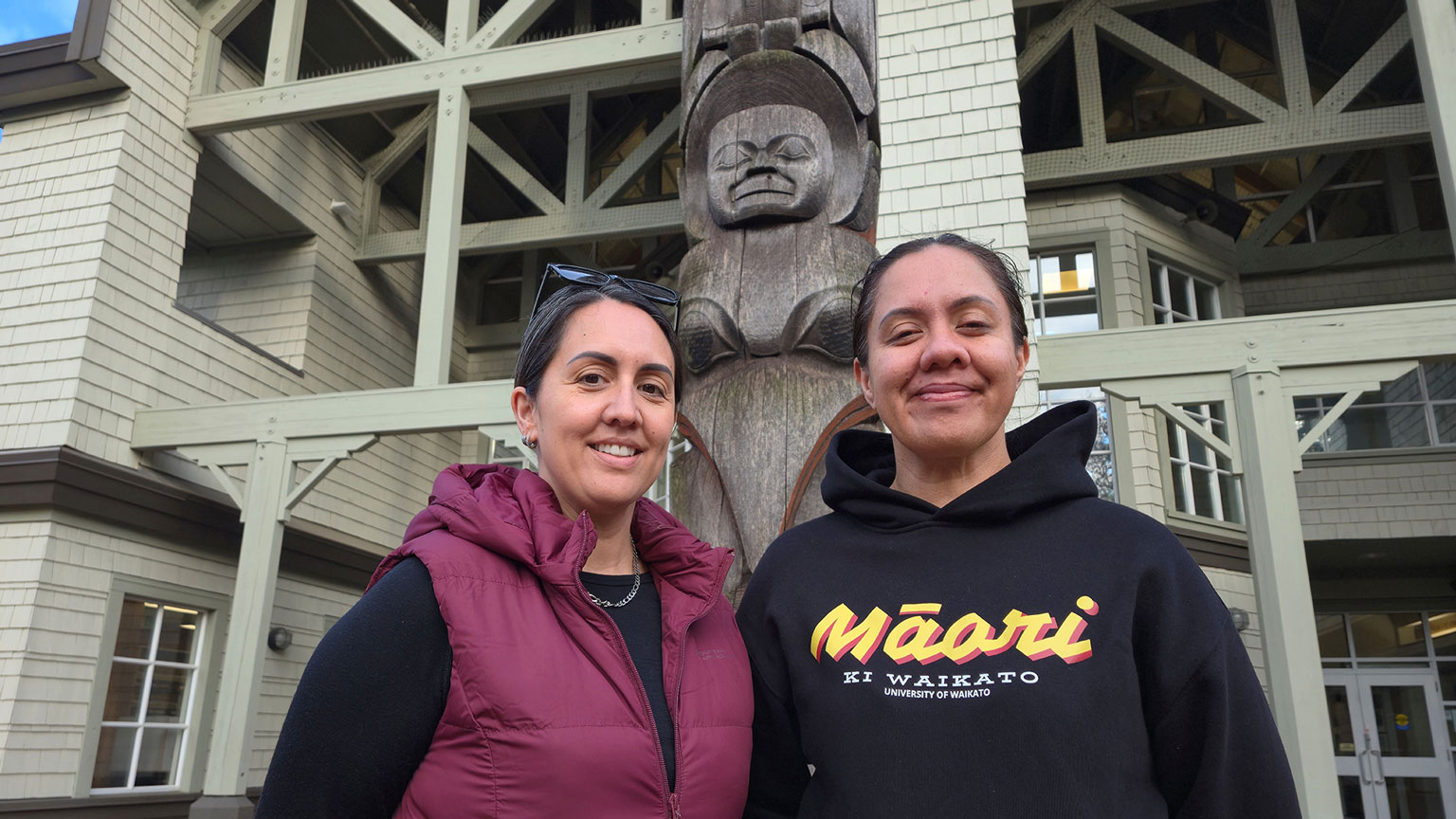
For two New Zealand students, it took a study abroad program that brought them to North Island College to bring each closer together.
Chae Phillips and Georgia-Louise Retikaukau are here as Queen Elizabeth Scholars. While the two live in different towns and had met briefly, only once they arrived in October did they recognize a shared connection back home.
“We actually figured out in the first week here that our daughters are friends, which we didn’t even realize,” Phillips said.
The main reason for the Queen Elizabeth Scholars (QES) programs is to bring together students from different countries and cultures. The Rideau Hall Foundation leads the QES program in collaboration with Universities Canada. The study abroad scholarship program is often geared toward longer study experiences but is applicable to project-based work as well. In this case, the two students each applied for the minimum two-month stay.
The program means students like Retikaukau and Phillips can come to North Island College. With funding available until 2028, students from NIC also get the chance for study abroad programs in other countries.
Retikaukau and Phillips are Māori. While here, they can make new connections with Indigenous people on Vancouver Island. Both are post-graduate students who have come to NIC for the opportunity to better inform their studies with their hosts.
“Programs like the Queen Elizabeth Scholars create meaningful opportunities for Indigenous students to connect with Indigenous communities around the world,” said Marisa Bennett, Executive Director, NIC Indigenous Education. “Those relationships can support students’ learning and create lasting connections across communities.”
Retikaukau, who is doing a PhD on spiritual and ceremonial practices of Māori women, has found a direct connection by meeting and learning with people from the north part of Vancouver Island.
“For me, it's just about building relationships with other peoples, Indigenous peoples, looking at how we can support each other and our process of revitalizing our languages and practices,” she said.
She had done her master’s thesis on Māori language. One thing that has stood out is that was the number of languages spoken by different communities in B.C.
“For us, the Māori language is really one language with different dialects,” she said.
She has taking opportunities such as an online class in the Nuu-chah-nulth language, which includes many students who live remotely and sometimes rely on generators for power.
“I admire them because they're all coming together online,” she said. “They're really wanting this. They're against all odds.”
With a background in health, Phillips is focusing her PhD research on integrating artificial intelligence into breast cancer care services. At home, the Māori face a lot of health inequity, particularly in areas like breast cancer, according to Phillips.
While here, she has been interested in learning more about the challenges Indigenous people in B.C. face when accessing health care, something that the Māori also face in New Zealand, or Aotearoa, as it is known in the Māori language.
“I think in terms of being Indigenous people, we sometimes feel isolated or, like, a little remote from other communities,” she said. “And it's that feeling of a struggle that we're doing this all on our own.”
While here, she has had opportunities, for example, to meet with NIC nursing students, which allows everyone to reflect on the work they are all doing and how it is similar.
“That's an empowering thing from an Indigenous perspective because we often feel very marginalized,” she said. “We may be physically or geographically worlds apart, but we're doing similar work in helping to build each other.”
As with other international programs, QES means more opportunities for NIC and institutions around the world to form partnerships and provide more cultural exchanges. For example, in late November, two Indigenous students from NIC left for New Zealand to take part in the Visionary Ancestors Program through the University of Waikato—Phillips and Retikaukau’s home institution.
All these exchanges add up to more ways for students to connect with others from around the world—and sometimes, in the case of Retikaukau and Phillips, the people you might not expect to see from your own backyard.